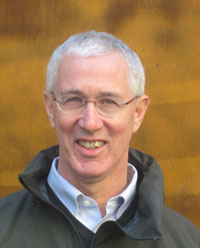
My research focuses on the circulation and wind forced response in the
Northwest Atlantic. An interest in shelf
problems has led to an exploration of the North Atlantic circulation and its
influence upon the shelf. I take an approach
involving experimental work at sea, interpreting data and numerical
modelling. The opportunity for such ecclecticism is what I like most
about oceanography. There is always a new idea to think, a new result to
explain or a new approach to explore.
I like numerical modelling because it enables us to integrate several different
aspects of the work and leads to applications in ocean ecology.
Within ocean ecology, I study the dispersal of plankton. Small organisms that cannot swim are moved about by ocean currents. Sometimes
this could be good, other times not.
Planktonic drifters include zooplankton and the eggs and larvae of fish.
I have worked on biological models on their own,
for example population models, but am
most interested in coupling biological models with physical
models to simulate the influence of the physical environment on these planktonic
organisms.
I am also interested in
new technology for sampling the ocean.
New ideas in oceanography have usually come from new observations. Spending more time at sea is not always the answer. We need
new observational approaches and sensors. Presently I am
working on using existing acoustic systems, such as Acoustic Doppler
Current Profilers (ADCPs), to provide new data on zooplankton.
I am also working on new platforms, such as gliders,
to extend our reach into the ocean.
There are many different routes into oceanography, from physics, mathematics,
biology, geophysics, engineering and others. My own background is
a PhD from UBC, a few years ago now, but my undergraduate degree is
in chemistry and physics.
There are usually several students, researchers, research associates and
technicians working with me. I am always interested in working with new
people so if this work sounds interesting please contact me.
I have developed several new courses over the past few years. I am
interested in new ideas and integrating new computational approaches with
teaching.
I am teaching two courses this fall, Computational Mechanics and Field Oceanography.
Physics 2820 - Computational Mechanics is designed to integrate computational techniques that are used in physics with the development of students' knowledge of classical mechanics.
Physics 6314 - Field Oceanography introduces students to the techniques and instrumentation of field oceanography.
The old courses that I have taught include
Physics 3300 - Physical Oceanography covers the basic concepts and equations of ocean dynamics.
Physics 6316 - Ocean Data Analysis is about the collection and exploration of ocean data from the ocean.
Physics 6324 - Modelling in Ocean Ecology - I have taught this course a few times now and it changes depending on the students in the course and on my own interest at the time.
I have taught quite a few other courses, including P1050, P2054,
P2055, P3820, P4205, P4300, P6302, P6310, P6321 and ES6001,
but these two are the courses that I will be teaching this year.
deYoung, B., F. Werner, H. Batchelder, F. Carlotti, O. Fiksen, E.E. Hofmann, S. Kim, H. Yamazaki and M. Kishi. 2010. Dynamics of marine ecosystems: integration through models of biological-physical interactions. In M. Barange, J.G. Field, R.H. Harris, E. Hofmann, R.I. Perry and F. Werner (Eds.) Global Change and Marine Ecosystems. Oxford University Press.
Davoren, G.K., P. Penton, C. May, B. Reinfort, N. Record, B. deYoung, C. Burke, W.A. Montevecchi, D. Andrews, A. Buren, M. Koen-Alonso, J.T. Anderson, C. Rose-Taylor, T. Bell and S. Garthe 2007. The importance of capelin (Mallotus villosus) in the Northwesta Atlantic. Journal of Northwest Atlantic Fisheries Science
39: 35-48
Rose, G.A., I.R. Bradbury, B. deYoung, S.B. Fudge, G.L. Lawson, L.G.S. Mello, R. Rideout, D.R. Robichaud, G. Sherwood, P.V.R. Snelgrove, and M.J.S. Windle. 2007 Rebuilding Atlantic do: Lessons from a spawning ground in coastal Newfoundland. In G.H. Kruse, K. Drinkwater, J.N. Ianlelli, J.S. Link, D.L. Stram, V. Wespestad and D. Woddby (eds). Resiliency of Gadid Stocks to Fishing and Climate Change Alaska Sea Grant College Program. University of Alaska Fairbanks.
B. deYoung and A. Jarre. 2007 Regime shifts: Methods of analysis. Encyclopedia of Ocean Sciences (eds.) J. Steele, S. Thorpe and K. Turekian.
B. deYoung, R. Peterman, R. Dobell, E. Pinkerton, Y. Breton,
T. Charles, M. Fogarty, G. Munro and C. Taggart. 1999.
Candian Marine Fisheries in a Changing and Uncertain World.
Can. Spec. Publ. Fish. Aquat. Sci. 129, 199p.
R. Greatbatch, Y. Lu and B. deYoung. 1996. Application of a Barotropic Model to North Atlantic Synoptic Sea Level Variability. J. Mar. Res. , 54, 451-469.
B. deYoung and F. Davidson. 1994. Modelling retention of cod eggs and larvae (Gadus morhua) on the Newfoundland Shelf. ICES Mar. Sci. Symp. , 198, 346-3550
C. Deacon, C. G., R. Goulding, C. Haridass, and B. deYoung. 1994. Demonstration Experiments With a Stirling Engine. Physics Education, 29, 180 183.
T. Mathieu, T. and B. deYoung. 1994. Application of a Mixed Layer Model to the Inner Newfoundland Shelf. J. Geophys. Res., 100, 921-936.
B. de Young and G. Rose. 1993.
On Recruitment and Distribution of Atlantic Cod (Gadus morhua)
off Newfoundland., Canadian Journal of Fishieries and Aquatic Sciences 50: 2729-2741
B. deYoung, R. Greatbatch, A. Goulding and V. Kumar. 1991. Bottom Pressure Variability on the Labrador Shelf: Model/Data Comparisons. J. Geophys. Res. , 97, 11323-11331.
B. deYoung and C.L. Tang. 1989. An analysis of Fleet Numerical Oceanographic Wind Data on the Grand Banks. Atmosphere-Ocean , 27, 414-427.
A. Hay. and B. deYoung. 1989. An oceanographic flip-flop: Deep water exchange in Fortune bay, Newfoundland. J. Geophys. Res. , 94, 843-853.
B. deYoung and S. Pond. 1988. The deepwater exchange cycle in Indian Arm, British Columbia. Estuarine and Coastal Shelf Science , 26, 285-308.
B. deYoung. and A. Hay. 1987. Density current flow into Fortune Bay, Newfoundland. J. Phys. Oceanogr. , 7, 1066-1070.
B. deYoung and S. Pond. 1987. The internal tide and resonance in Indian Arm, British Columbia. J. Geophys. Res. , 92, 5191-5207.
D.K. Cairns. and B. deYoung, 1981. Back-crossing of a Common Murre ( Uria allge x U. lomvia ) The Auk , 98, 16-17.
M.H. Brooker and B. deYoung. 1980. Measurement of the stability constants for aqueous calcium and magnesium nitrite by Raman spectroscopic methods. J. Solution Chemistry , 9, 279-288.
M.H. Brooker. and B. deYoung. 1980. Preparation and Raman spectra of Ca(NO2)2.H2O, Ca(NO2)2 and Mg(NO2)2.H2O. J. Inorganic and Nuclear Chemistry . 42, 1217-1221.